Deep Conversation Questions for Every Mood

Start with these three deep conversation questions: “When do you feel truly understood?”, “What small thing means a surprising amount to you?”, and “What would you like to understand better about yourself right now?” Choose one that fits the mood, take turns answering, and let anyone say “Pass” without explaining.
Getting started: take turns, with no pressure to answer
At the kitchen table or on a video call, start by asking, “Are you in the mood for a personal question?” Suggest a short round rather than planning a whole evening around it. If someone is tired, about to head out, or still upset after an argument, choose another time.
Open-ended questions leave more room for an honest answer than yes-or-no questions. The Gottman Institute recommends openings such as “What does … mean to you?” or “How do you experience …?” Ask about the other person’s experience, not for the answer you hope to hear.
The colors help you choose: green is light, yellow is more personal, and red is especially sensitive. You don't have to work your way through the colors.
- •You can both answer the same question; neither of you has to.
- •Anyone can pass without explaining.
- •Before asking a follow-up, try: “Would you like to tell me more about that?”
- •Ask before offering advice: “Would you like an idea, or would you rather I just listen?”
- •Don't use a personal answer against someone later.
Green: light questions for dating and getting to know someone
Ground rule: share only as much as feels comfortable today. A short answer is enough.
These questions work on a walk after a date or during your first long conversation on the couch. They leave room for personal answers without jumping straight into painful experiences.
- •What little everyday thing makes you feel instantly at ease?
- •What side of you do people usually discover only after they've known you a while?
- •When did you last try something for the first time, and what was it like?
- •How can you tell when you can be completely yourself around someone?
- •How would you spend a free afternoon if you weren't going to tell anyone about it?
Green: funny, honest questions for friends
Ground rule: laugh together, not at someone's sore spot. A funny answer can have something serious behind it, too.
These deep conversation questions work around the kitchen table with friends or on a relaxed evening with your partner. You don't have to stay deep all night: a larger replication study found no reliable negative link between small talk and life satisfaction. Light conversation isn't failed deep conversation.
- •What completely unimportant thing do you defend with surprising passion?
- •What odd habit of yours actually has a good reason behind it?
- •If your everyday life came with a harmless warning label, what would it say?
- •What shared memory still makes you laugh—and why does it matter to you?
- •What might people misunderstand about you if they only know you casually?
- •What small tradition would you like to start with your friends?
Yellow: personal questions for everyday life as a couple
Ground rule: speak from your own perspective. If someone says, “I sometimes feel overlooked,” start by listening—not listing every example that proves otherwise.
These questions can be useful even after years together. Choose just one over a cup of tea. In a study of couples, attentive listening when a partner shared stressful experiences was associated with better shared coping and greater relationship satisfaction. You don't always need another clever question.
- •When have you felt especially connected to me lately?
- •What's been on your mind day to day that I might be missing?
- •What kind of support helps when you're worn out?
- •What side of you doesn't get enough room in our everyday life together?
- •What would you like to tell me more often, but rarely find the right moment to say?
- •What small thing have I done lately that you appreciated?
Yellow: thought-provoking questions about the future
Ground rule: an answer is a thought, not a promise. A wish doesn't have to become a plan right away.
These questions suit couples and friends, especially when something is changing: a move, a new job, or a different idea of how you want everyday life to look. Keep understanding separate from deciding. Today, you can learn about a wish; you can discuss what to do about it later.
- •How has your idea of a good life changed?
- •What would you like more room for in your daily life, even if it doesn't look impressive to anyone else?
- •What would you like to keep or build for yourself, independently of other people?
- •What change feels both exciting and scary to you?
- •A year from now, what would you like to look back on with happiness?
- •What expectation of yourself would you like to ease up on?
Red: sensitive questions about closeness, wishes, and boundaries
Ground rule: ask explicitly whether the topic is welcome right now. Agreeing to a conversation does not mean agreeing to touch or anything that might happen afterward.
Your boundaries depend on what you're comfortable with. No one owes a partner physical or sexual closeness. Choose a calm moment without time pressure for sensitive topics; “I don't want to talk about that” needs no defense.
These questions are meant to help you express wishes and boundaries. They're not an invitation to demand secrets or details about past experiences.
- •What kind of closeness would you like right now, and what doesn't feel right today?
- •How can I ask what you want without making you feel pressured to answer?
- •What words help you state a boundary clearly?
- •What would you rather bring up yourself than be asked about?
- •How would you like me to respond if you need some space during a personal conversation?
When to stop: clear ground rules for pausing
Stop as soon as someone says “Stop,” “Pass,” or “Not today.” You don't need a complete answer or a shared solution to end the conversation.
Irritability, sarcasm, repeatedly defending yourself, withdrawal, or physical tension are reasons to check in. Tears don't automatically mean someone wants to stop. Ask: “Would you like to keep talking, sit quietly together, or leave it here for today?”
The Gottman Institute describes how emotional flooding can make listening and understanding harder. When that happens, a break to settle down is more useful than another question. If you're dealing with fear, violence, or manipulation, your safety comes before the conversation; seek support from someone you trust or a professional support service.
- •Explain the pause without blame: “I'm noticing I can't listen properly right now.”
- •Don't push for one last answer.
- •After someone shares something personal, ask: “What do you need from me right now?”
- •Respect a request for space.
- •Agree to return to the conversation only if you both want to.
- •If needed, finish with something ordinary: make tea, have something to eat, or unwind separately.
A small ritual instead of a long list of questions
Try a short round on your next free evening: turn off notifications, choose a light question, and take turns answering. Add a more personal question only if you both feel like it. To finish, each person can share what stayed with them from the conversation.
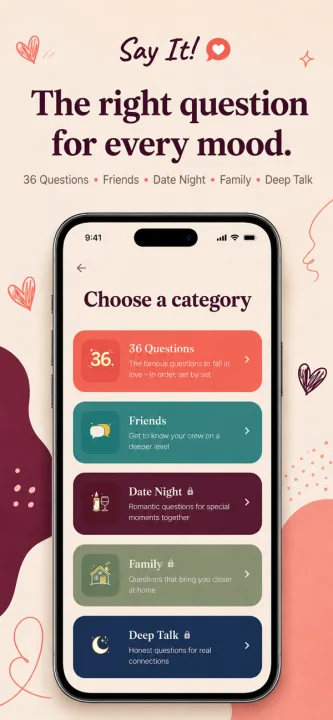
If you'd rather not hunt for questions yourself, the premium Deep Talk deck in Say It! has 100 questions per language. Treat a question you draw as an invitation to talk, not a test with a right answer.
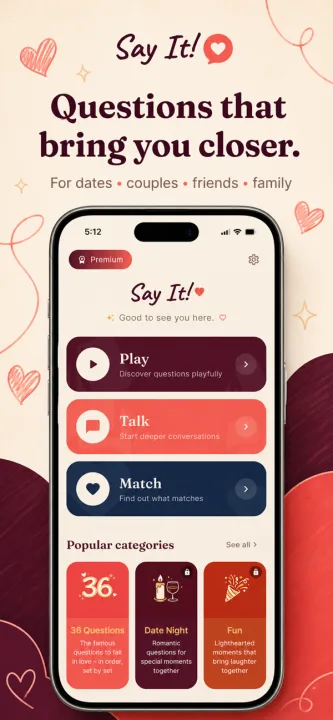
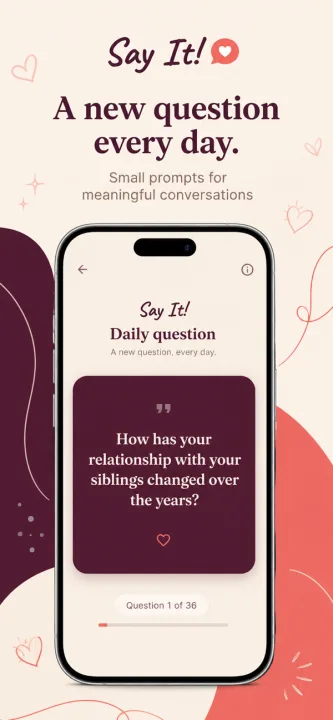
Say It! helps you get started: draw a question and talk together—using one phone, fully offline, with no account needed.
- •Settle in: choose a question from the green category.
- •Listen: let both people answer if they want to, without jumping straight into follow-ups.
- •Go deeper: move to yellow only if you both feel like it.
- •Wrap up: “How did that feel for you?”
- •Afterward, let the evening be light again.

Say It!
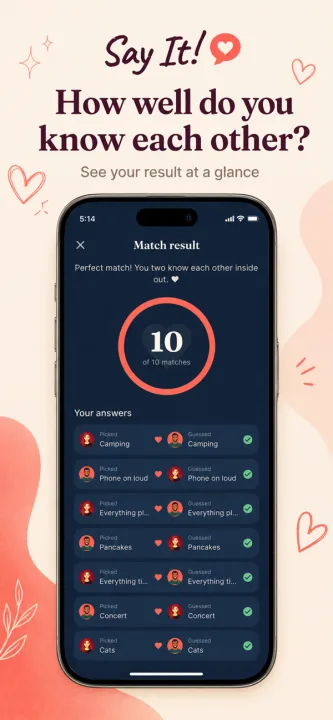
Conversation starters, the 36 questions to fall in love and a Match mode. Perfect for dates, couples, friends and family.