Get to Know You Games for Adults: 6 Easy Icebreakers

Good get-to-know-you games for adults have simple rules, low-pressure prompts, and the option to pass. Try partner interviews, finding things in common, choosing a spot on a spectrum, question rounds, people bingo, or a quick chat check-in. Below are six games for teams, roommates, clubs, and video calls, with group sizes, timings, and materials.
Before you start: Keep introductions low-pressure
In a new group, people are often trying to get their bearings: Who’s here? What’s expected? Where do I fit in? The early stage of the [group development model explained by MIT Human Resources](https://hr.mit.edu/learning-topics/teams/articles/stages-development?trk=article-ssr-frontend-pulse_little-text-block) describes this search for orientation. Start with names and everyday preferences rather than personal struggles or confessions.
The [University of Florida’s guidance on icebreakers](https://ask.ifas.ufl.edu/publication/WC356/pdf) highlights three useful criteria: everyone can participate, people learn something about one another, and the activity stays brief. The timings and group sizes below are practical planning suggestions.
You could introduce a game like this: “We’ll take eight minutes to learn a few names and interests. You decide what to share, and you can pass at any time. Then we’ll move on to today’s main topic.”
- •Make it optional: Anyone can pass without explaining why. Nobody needs to defend an answer.
- •Choose easy topics: Start with food, hobbies, music, or small everyday experiences. Avoid compulsory intimate questions or asking people to judge others.
- •Make it accessible: Offer a seated or spoken alternative to any activity that involves moving around.
- •Think about group size: Split larger groups into pairs or trios for longer conversations. Keep any whole-group sharing brief.
- •Match the setting: Try partner interviews at work or in workshops, question rounds with roommates or at birthdays, Pick Your Spot at a club or sports group, and a chat check-in online.
1. Partner interviews: Put a small story to a name
At a workshop table or a first team meeting, each person starts by talking to just one other person. It’s a manageable alternative to a long round of introductions in front of everyone.
- •Goal: Learn names and find an easy conversation starter.
- •Group size and timing: 4–16 people, around 10–15 minutes.
- •Materials and setup: No materials needed. Pair people who don’t already know each other where possible. Make one trio if you have an odd number.
- •Step 1: Each person shares their name and answers two questions: “What do you enjoy doing on a free afternoon?” and “What would you like to get out of today?”
- •Step 2: Swap roles after two minutes. In a trio, give everyone equal time.
- •Step 3: Before introducing your partner, ask, “Which parts can I share with the group?” Each person then introduces their partner in no more than 20 seconds.
- •Wrap-up: Ask, “Did you hear anything you could connect over?” Two or three volunteer answers are enough.
- •Variation: At a school parent meeting, change the second question to “What are you hoping we’ll discuss today?” Online, send pairs into breakout rooms.
2. Three things in common: For roommates, birthdays, and new teams
Three people at the kitchen table look for something they share: listening to podcasts while cooking, a favorite late-night snack, or the same least-favorite chore. The conversation happens while they search, not just when they report back.
- •Goal: Discover shared interests and everyday habits.
- •Group size and timing: 6–30 people in trios, around 8–10 minutes.
- •Materials and setup: No materials needed. Divide everyone into groups and give an example.
- •Step 1: Give each trio five minutes to find three things they have in common. “We’re all here today” doesn’t count; specific preferences and experiences do.
- •Step 2: Anyone can skip a topic. The things you share don’t have to be especially unusual.
- •Step 3: Each trio shares just its most surprising discovery with the whole group.
- •Wrap-up: Ask, “Who would you like to keep talking with about this later?” Nobody needs to answer in front of everyone.
- •Variation: In a sports group, focus on workout music, everyday ways to stay active, or favorite training times. Online, use breakout rooms for three.
3. Pick your spot: A quick icebreaker for clubs and workshops
Asking people to choose a spot along a spectrum makes similarities and differences visible. [Germany’s Federal Agency for Civic Education describes these positioning activities](https://www.bpb.de/system/files/dokument_pdf/Anlage_03_Kennenlernen.pdf) as a way to help people get acquainted and encourage interaction. Build in short conversations rather than simply asking everyone to pick a position.
- •Goal: Get people talking and discover different preferences.
- •Group size and timing: 8–40 people, around 5–8 minutes.
- •Materials and setup: No materials needed. Identify two sides of the room, or offer two response options for a seated version.
- •Step 1: Explain a spectrum, such as “early bird” at one end and “night owl” at the other. People can choose any point in between.
- •Step 2: Invite everyone to choose a spot if they want to. Alternatively, they can describe their position from their seat.
- •Step 3: Give people near each other one minute to discuss their choices. Repeat with “Planned vacation or spontaneous trip?” and “Music or quiet while cooking?”
- •Wrap-up: Ask two volunteers to share something they discovered they had in common. Nobody has to explain their position publicly.
- •Variation: For a sports club, try “Indoor or outdoor workouts?” and “Exercise alone or with others?” On a video call, use chat or a poll.
4. Pick-a-question round: For roommates and parties
At a small birthday gathering or around a shared kitchen table, a few questions are enough. The important part is having a choice: each person can pick one of two questions or sit out entirely.
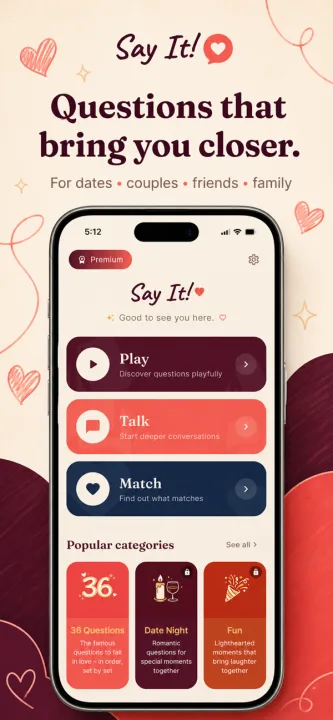
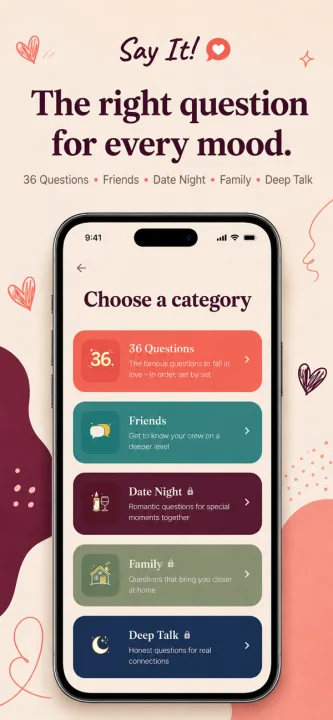
If you’d rather not prepare prompts, Say It! offers conversation questions in Talk mode and a free Friends deck. Everyone plays on one phone, fully offline, with no account needed.
- •Goal: Learn about people’s preferences without asking for intimate details.
- •Group size and timing: 3–8 people per group, around 10–15 minutes.
- •Materials and setup: A short question list on paper or a phone. Agree on a time limit before you start.
- •Step 1: Read out two questions, such as “What food turns a rough day around for you?” and “What small skill would you like to learn?”
- •Step 2: Each person chooses one question and answers for up to a minute, or passes.
- •Step 3: Allow one friendly follow-up question per answer, then move to the next person.
- •Wrap-up: Finish at the agreed time. Anyone who wants to can suggest a topic to come back to later.
- •Variation: At work, try “What small shortcut makes your workday easier?” and “What makes a good break for you?” Online, the host reads the questions aloud.
5. People bingo: Make several quick connections in a big group
At a club kickoff or a bigger birthday party, you don’t need everyone to speak in turn to the whole room. A small bingo card gives people a reason to strike up several short conversations instead.
- •Goal: Learn several names and discover people’s interests.
- •Group size and timing: 12–40 people, around 12–15 minutes.
- •Materials and setup: Prepare a nine-square card and a pen for each person. Use statements such as “enjoys cooking,” “likes audiobooks,” or “can recommend a local day trip.”
- •Step 1: Everyone looks for willing conversation partners. If a statement fits, that person can write their name in the square.
- •Step 2: Ask a quick follow-up for each match, such as “What’s your favorite thing to cook?” The same person can fill no more than two squares on any one card.
- •Step 3: Stop the search after eight minutes. Nobody needs to fill their card, and signing is optional.
- •Wrap-up: Collect three interesting conversation topics rather than naming the people with the most matches.
- •Variation: For a seated version, only those who want to move change places. Alternatively, each table can work on one shared card. Online, send the template in advance and run several short breakout sessions.
6. Quick chat check-in: An online get-to-know-you game
On a video call, everyone can contribute a short answer at the same time. [Indiana University’s icebreaker guide](https://citl.indiana.edu/teaching-resources/guides/icebreakers.html) lists chat, polls, and breakout rooms as possible formats for online icebreakers. Start with a question that doesn’t ask people to reveal anything private.
- •Goal: Put names and small everyday preferences on screen.
- •Group size and timing: 4–30 people, around 5–8 minutes.
- •Materials and setup: A video call with a chat function. Post the opening question in the chat so everyone can see it.
- •Step 1: Ask, “What’s one small thing that makes your break better?” Give everyone 30 seconds to think.
- •Step 2: Anyone who wants to types a short answer, then sends it on your signal. Speaking an answer aloud is also fine.
- •Step 3: Give everyone a moment to read the replies. Invite no more than three volunteers to add something, with 30 seconds each.
- •Wrap-up: Point out shared preferences without judging them: “Quite a few of us like stepping outside during a break.”
- •Variation: For more conversation, follow with four minutes in pairs in breakout rooms. If there’s no chat function, invite people to answer in turn, keeping the option to pass.
Which game fits? Plan your first 15 minutes
Choose one game with a clear time limit rather than stacking several activities back to back. For a brief introduction, use one of the shorter options here. Leave a little room for people to keep talking if they discover a shared interest.
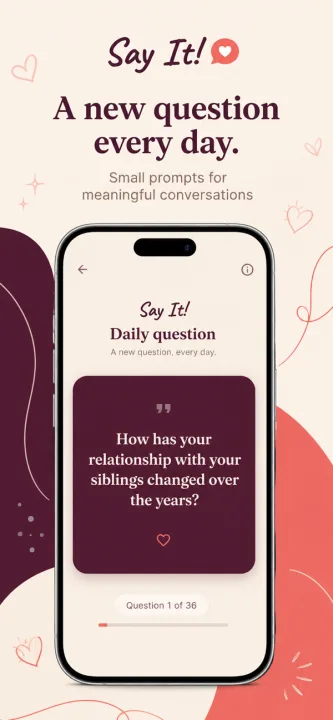
For more questions around the kitchen table, Say It! keeps things simple: draw a question, talk, and get to know each other better.
- •Team or workshop: Take one minute to explain, four minutes for partner interviews, then give brief introductions. Keep questions relevant to the occasion.
- •Roommates or birthday gathering: Explain the rules in a minute, then start a question round at the table. Stop the game if a natural conversation takes over.
- •Large club or sports group: Start with Pick Your Spot. Leave time afterward for people to carry on their conversations.
- •School parent meeting: Use partner interviews to explore what people hope to get out of the meeting. There’s no need to discuss private family circumstances.
- •Remote team: Begin with the chat check-in, then add a short conversation in pairs if useful.

Say It!
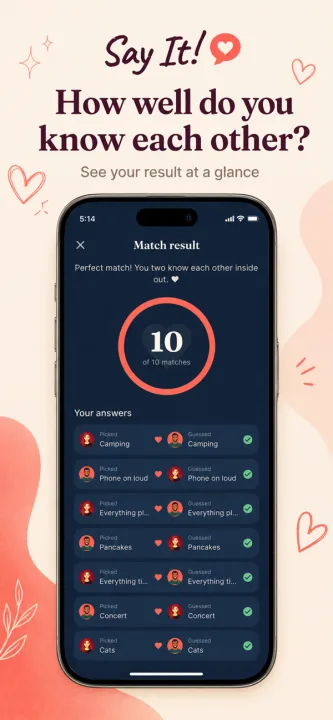
Conversation starters, the 36 questions to fall in love and a Match mode. Perfect for dates, couples, friends and family.